

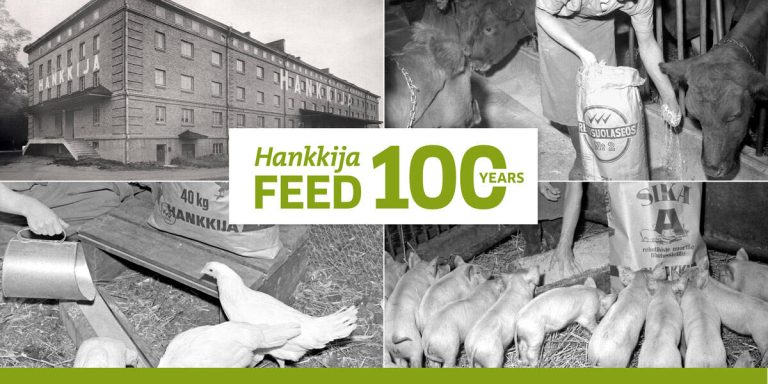
Hankkija’s feed industry has shaped Finnish livestock production for a century. From the first compound feed mixtures in 1926 to modern functional feed innovations, development has been driven by research, raw material expertise, and close cooperation with farms. Over the decades, feed production, factory investments, and nutrition research have continuously evolved to support productivity and performance in Finnish animal production.
The need for balanced energy and protein in livestock feeding
At the beginning of the century, livestock production was limited by a lack of energy and protein in feeding. Both Pellervo magazine and farmers demanded that Hankkija establish a compound feed mixing plant to solve this problem. On June 12, 1926, Hankkija’s board presented an investment plan to the supervisory board. A property near Malmi railway station in Helsinki was purchased from a competitor, Agroksela. The site had previously been used for grinding and mixing feed raw materials.
Master of Science Lauri Paloheimo, assistant at the University of Helsinki, was hired to oversee the manufacture of compound feeds and their promotion.
The launch of Hankkija’s first compound feeds
The mill and mixing plant were renovated for their new purpose. In August 1926, Hankkija produced and delivered its first cattle feed to stores, Hankkija’s Compound Feed Mix No. 1. This was later followed by a more affordable version, No. 2.


Research based feed formulations and wartime adaptation
Production of chick and laying hen feed mixtures began in 1929. What was new about Hankkija’s feeds was their research based formulation and carefully calculated raw material ratios. The goal was to achieve a balanced protein and amino acid profile. Lauri Paloheimo later became Professor of Animal Science at the University of Helsinki.
Feed production grew steadily until the Winter War. The war halted the import of feed raw materials, and high quality ingredients became scarce. As a solution, cellulose based feed was produced for cattle and for horses used by the army and in forestry work. The feed cellulose had to be supplemented with minerals. This led to the development of mineral feed production.

Rebuilding and expansion of feed factories after the war
After the war, raw material availability improved. In 1951, Hankkija purchased a factory in Kolppi, Pietarsaari, to serve customers in Northern Finland. In 1955, a third factory was built in Koria to serve customers in Kymenlaakso and Eastern Finland.
The location suited the spirit of 1950s bilateral trade. Feed raw materials were purchased from the Soviet Union, transported by rail to Koria, and processed into feed. In 1959, Hankkija built a modern and highly automated factory in Turku. It replaced the Malmi mixing plant that had operated for over 30 years.


In 1965, Hankkija built a large grain storage and seed center in Seinäjoki. A feed factory was added in 1968. Hankkija played a strong role in developing Southern Ostrobothnia’s transition from hay and oat production to barley and wheat cultivation. The Seinäjoki factory later burned down. A new and modern plant was built in 1977.
Strong investment in feed and nutrition research from day one
In 1956, Hankkija launched its first pig feed mixture, Pig Feed Mix A. It was followed by the finishing feed O. During the 1960s, the Nasu product family was built around pig feeds. It became Hankkija’s largest feed product group as pig production expanded.

In autumn 1957, Hankkija began producing pelleted poultry feeds in Malmi. Pelleting was a technical innovation. It improved feed hygiene, prevented ingredient separation, and worked efficiently in automatic feeding systems.
At the Anttila experimental farm, feeding strategies were developed for broilers introduced to Finland in the late 1950s. In 1965, a mink research facility was built in Anttila to develop fur animal feeds. Dairy cattle feeding research was conducted at the Nikkilä experimental farm. Pig feed research was carried out in cooperation with external test farms.
Between 1960 and 1980, feed compound production in Finland increased tenfold in tonnage. The feed industry evolved into large scale production, with Hankkija as market leader.
In 1982, Hankkija launched the TuMa program for livestock farms. The program improved farm production conditions and planned supplementary feed needs. New computer technology was used to calculate feed usage. Domestic feed analysis was introduced. Linear optimization enabled the creation of target oriented feeding plans.
Market leadership and ownership changes in the Finnish feed industry
In the early 1980s, Suomen Sokeri Oy held a dominant position in the Finnish sugar market. It had long supplied molasses and molassed beet pulp to farms and to the feed industry. In 1981, the company entered the feed industry by acquiring Turun Muna Oy, one of Finland’s largest feed companies and the leading poultry feed manufacturer.
In 1982, Suomen Sokeri, later renamed Cultor, acquired Vaasanmylly Oy. This was the largest acquisition in the history of Finland’s food industry at the time. After restructuring, seven factories were consolidated into three. In 1985, they were merged into Suomen Rehu Oy.

In 1992, during the severe Finnish recession, Hankkija’s feed business was sold to Cultor’s Suomen Rehu Oy. Production was consolidated and several factories were closed. Operations were centralized in Kotka, Turku, Vaasa, and Seinäjoki.

In 2007, Hankkija’s feed industry returned to Hankkija. Between 2012 and 2016, Hankkija became part of Danish Agro. In 2018, the Suomen Rehu brand was replaced by the Hankkija brand.
Hankkija’s feed research has strongly focused on supporting intestinal function in livestock
In the 1950s, antibiotics were commonly used in feed to reduce diarrhea and improve feed efficiency and growth. In the 1990s, concerns about antimicrobial resistance led to a shift in approach. The focus moved from routine antibiotic use to supporting animals’ natural resilience.
In 1999, Progut®, based on yeast hydrolysates, was launched to support intestinal functionality (Progut® Extra). In 2014, Progres®, based on resin acids from pine oil, was introduced. Finland banned feed antibiotics in 1999, and the European Union followed in 2006. Today, antibiotics are permitted only for therapeutic use.


Milk yields increased significantly from the 1980s to the 2000s. Average annual milk yield per cow in Finland rose from 5000 kg to over 10,000 kg. Top herds exceed 15,000 kg. Similar progress has been achieved in pig, broiler, and layer production. Nutrition has played a central role in this development.
Today, Hankkija is the market leader in its field, and its investment in research continues.
In 2024, Hankkija launched ProHumi®, functional feed ingredient processed from selected peat material, rich in fiber and humic acids. The product is designed to support intestinal function and productivity. In the same year, Hankkija introduced Resipro® Foam, a cleaning agent based on resin acids and pine oil soap.


Today, Hankkija operates feed factories in Seinäjoki, Turku, and Kotka. The company manufactures feed for all livestock species. Hankkija is the only company in Finland conducting significant international level feed and nutrition research with its own staff and global research network. The company remains the market leader in the Finnish feed industry, and its commitment to research continues.
Related
-

Progres® in piglet nutrition: Reduced post-weaning diarrhea incidence and improved performance after weaning
-

Enrichment materials for pigs
-
Hankkija’s feed industry – 100 years of feed innovations
-

SPF-level quality in Feed Materials: audits, traceability and testing for verified control
-
European Veterinary Congress of Behavioural Medicine and Animal Welfare 2025
-
Hankkija at Sikaseminaari 2025: Strengthening swine biosecurity and feed safety