
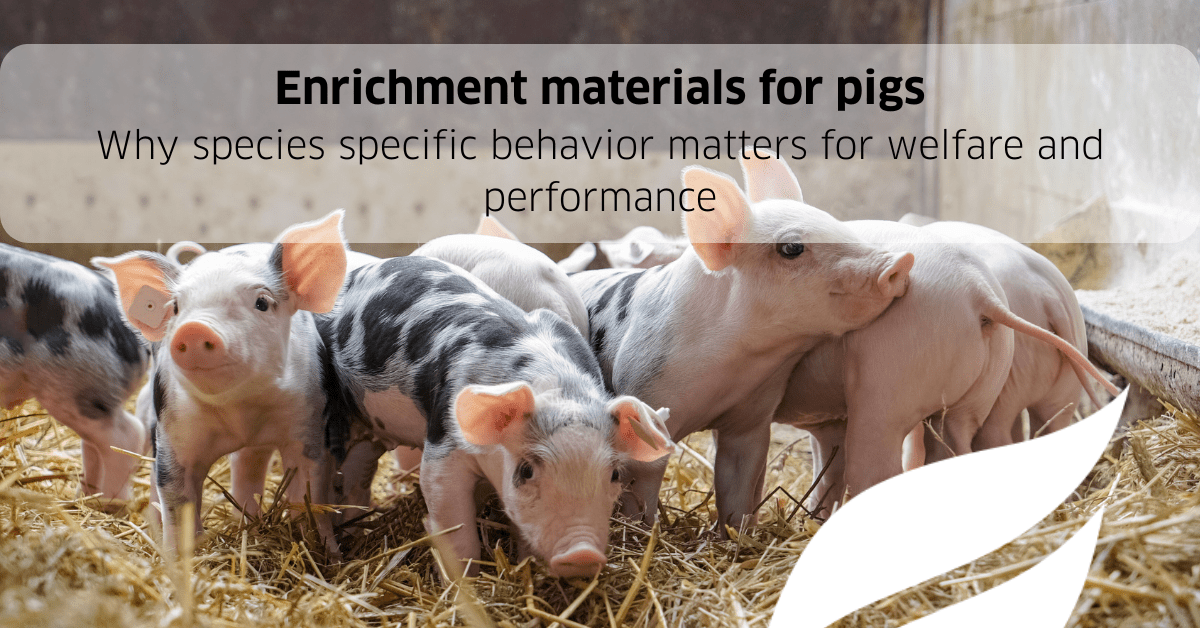
Why species specific behavior matters for welfare and performance
Intensive pig production places high demands on efficiency, biosecurity, and animal welfare. One critical yet sometimes underestimated factor is the role of enrichment materials. Providing pigs with opportunities to express natural behavior is not only a legal requirement in the European Union, but also a key driver of welfare, health, and production performance. Understanding how enrichment works, and which materials are truly effective, is essential for modern pig farming systems.
Life in intensive pig production
In modern pig production, animals often have few to root, forage, and explore, even though these behaviors are essential for pigs. When pigs cannot express natural behavior, frustration and chronic stress may develop. This increases the risk of damaging behaviors such as tail biting and ear biting, which negatively affect welfare.
The role of enrichment in pig welfare
Enrichment materials are designed to support natural pig behavior and improve overall welfare. In the European Union, providing enrichment is legally required, and several countries have additional national regulations. Proper enrichment reduces inactivity and pig directed aggression. It also helps pigs cope better with challenging production phases such as weaning. Welfare improvements are closely linked to measurable production outcomes, including improved feed intake, growth rate, reduced tail damage, and better carcass quality. These effects create clear economic value for farmers.
What makes an enrichment material suitable
Suitable enrichment materials must be safe, malleable, and attractive for pigs to interact with and consume. Straw, hay, and silage are widely recommended and considered effective options.
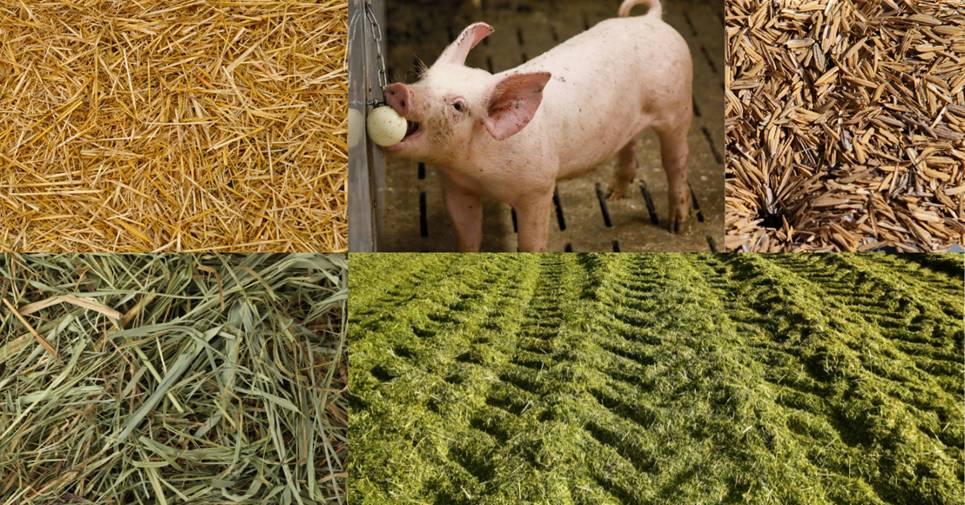
Materials such as wood and bark are less suitable. Chains, ropes, and rubber objects are regarded as marginal and should only be used together with more appropriate materials.
Although straw is often considered the gold standard, it can create practical challenges. These include slurry system blockages and hygiene risks. Straw and hay may also introduce mycotoxis, pathogens such as Salmonella, or molds to the farm. Availability and cost consistency can pose additional limitations.
ProHumi® peat pellets as an alternative enrichment material
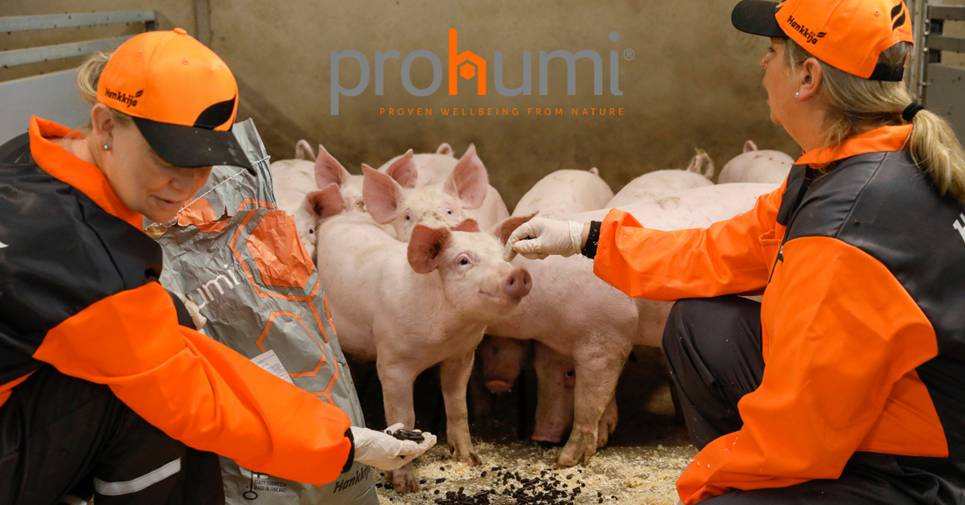
ProHumi® peat pellets offer a practical alternative feed material that can be used as enrichment for pigs. The 8 mm pellets are designed for consumption and provide biologically active substances. They are rich in inert fiber and humic acids that support gut function while not causing slurry system blockages.
Rigorous pre- and post- processing testing ensures consistent quality and verifies both microbial and nutritional safety.
Effects on behavior and gut function
Research on ProHumi® is still ongoing, but preliminary findings are promising. Observations show reduced pig directed manipulative behavior and increased foraging and play behavior.
Additional benefits include improved growth performance, reduced post weaning diarrhea incidence, increased butyric acid levels in the gut, and a more favorable gut microbiota profile. Increases in beneficial bacteria such as Bifidobacteria and reductions in E. coli have been reported.
A practical enrichment solution for modern pig farms
ProHumi® peat pellets combine welfare benefits with practical farm management advantages. They support natural pig behavior, contribute to gut function, and integrate well into modern production systems.
As enrichment strategies continue to develop, solutions that balance welfare, biosecurity, and production efficiency are becoming increasingly important in sustainable pig production.
Other literature:
- Godyń, Nowicki, Herbut, 2019. Effects of Environmental Enrichment on Pig Welfare—A Review. Animals 9: 383. https://doi.org/10.3390/ani9060383
- Kettunen, Rinttilä, Vuorenmaa, Apajalahti, 2024. Effects of peat and lignocellulose on the colonic fermentation of pigs in an ex vivo simulation model. Conference presentation and abstract in: 75th EAAP Annual Meeting, September 1-5, 2024, Florence, Italy.
- Kettunen, Vuorenmaa, 2024. Modular approach for the R&D of novel feed supplements for improved sustainability of pig production: case study of humic-rich prebiotic fiber product development. Pig Research Summit, November 20-21, 2024, Copenhagen, Denmark
- Kettunen, Vuorenmaa, Partanen, 2024. Peat pellets as enrichment material had positive effects on growth and intestinal microbiota of weaned piglets. Conference presentation and abstract in: 75th EAAP Annual Meeting, September 1-5, 2024, Florence, Italy.
- Mkwanazi, Ncobela, Kanengoni, Chimonyo, 2017. Effects of environmental enrichment on behaviour, physiology and performance of pigs — A review. Asian-Australasian Journal of Animal Sciences 32: 1-13. https://doi.org/10.5713/ajas.17.0138
- COMMISSION RECOMMENDATION (EU) 2016/ 336 – of 8 March 2016 – on the application of Council Directive 2008/ 120/ EC laying down minimum standards for the protection of pigs as regards measures to reduce the need for tail-docking
Related
-

Progres® in piglet nutrition: Reduced post-weaning diarrhea incidence and improved performance after weaning
-

Enrichment materials for pigs
-
Hankkija’s feed industry – 100 years of feed innovations
-

SPF-level quality in Feed Materials: audits, traceability and testing for verified control
-
European Veterinary Congress of Behavioural Medicine and Animal Welfare 2025
-
Hankkija at Sikaseminaari 2025: Strengthening swine biosecurity and feed safety